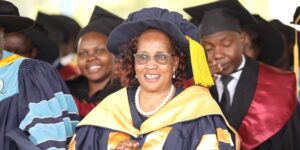
Prof. Josephine Ngaira
Director
Welcome to the Institute of Indigenous Knowledge, Cultural Studies, and Climate Change (IIKCC). It is my great privilege to lead an institute committed to preserving our rich cultural heritage while advancing innovative, community-driven solutions to the challenges of climate change.
At IIKCC, we recognize that Indigenous Knowledge is not only a foundation of identity and heritage—it is also a powerful resource for sustainable development. Our work bridges generations, bringing together scholars, community elders, cultural custodians, and climate experts to document, protect, and apply knowledge systems that have guided communities for centuries.
Through research, cultural studies, training, and community engagement, we strive to ensure that traditional wisdom remains relevant and respected in today’s rapidly changing world. We believe that climate resilience is strongest when informed by local knowledge, cultural values, and scientific understanding.
As we grow, our goal is to become a center of excellence that empowers communities, strengthens cultural awareness, and inspires environmental stewardship across the region and beyond.
I warmly welcome students, researchers, partners, and stakeholders to collaborate with us in this important journey. Together, we can safeguard our heritage, honour our cultures, and build climate-resilient futures for generations to come.
The Institute of Indigenous Knowledge and Cultural Studies (IIKCS) is a strategic research centre that was established in October 2020 under the MMUST Statutes. The Institute has been modelled around the fast-growing niche of Local and Indigenous Knowledge Systems (LINKS) as conceived by the United Nations Educational, Scientific and Cultural Organization (UNESCO), within the United Nations Sustainable Development Goals framework.
IIKCS activities are focused on the four thematic areas namely; Biodiversity, Climate Change, Science Policy and Knowledge Transmission. On Biodiversity, IIKCS focuses on how various indigenous communities in Africa and beyond have been interacting with various forms of life, and how such interactions are being addressed by the various policies, especially the Convention of Biological Diversity (CBD 1992) and the Nagoya Protocol on Access and Benefit-Sharing. Climate Change is addressed in the context of the Paris Agreement regarding its impacts on the livelihoods of various indigenous people, biodiversity and ecosystem services.
Being an affiliate of an institution of Higher Education, IIKCS is a research and policy driver towards curriculum review and development for the protection and integration of indigenous languages, knowledge and cultures as essential components of academic excellence and research.
IIKCS promotes the interaction between formal education with real life situations where culture, biodiversity and environment are indispensable components of humanity. IIKCS academic, research, innovation and outreach activities are geared towards policy development and implementation for a healthier and cohesive world with a strong foundation that is built on diversity of local and indigenous knowledge and culture. In partnership with communities, industries, NGOs, businesses and governments, IIKCS is a one stops centre through which MMUST honours the commitment to these relationships..
1. Prof. Peter Bukhala, Chair-IIKCS Committee
2. Rev. Prof. Judith Achoka, Member
3. Prof. Stanley Omuterema, Member
4. Dr. Lucy Mandillah, Secretary,
5. Dr. Lydia Anyonje, member
6. Dr. David Barasa, member
7. Dr. Fr. Kizito Muchanga, member
8. Dr. Ochieng Ahaya, member
9. Dr. Humphrey Agevi, member
10. Mr. Wakungwi Sakwa, member
Vision Statement
A well-established Institute entrenched in the development and promotion of Indigenous Knowledge and Culture locally, nationally, regionally and internationally.
Mission Statement
To be an Institute of Excellence towards attaining the globally important multidisciplinary niche in Indigenous Knowledge and Cultural Studies for sustainable development.
Strategic Objectives
1. Creating internal and external linkages with various schools and researchers through relevant SDGs in addressing matters relevant to local and indigenous knowledge systems.
2. Develop and strengthen academic and research programs that support local and indigenous knowledge systems.
3. Support the growth of semi-autonomous academic and research centres of excellence dealing in local and indigenous knowledge systems
4. Stimulate research and innovations by mobilizing development of research concepts and proposals in local and indigenous knowledge systems for internal and external funding.
5. Promote publishing of research articles within the field of local and indigenous knowledge systems in reputable journals.
6. Promote the adoption of the concept ‘local and indigenous knowledge systems’ and associated terms in publications and other activities to harness the achievement of the niche area.
7. Conduct community outreach activities related to local and indigenous knowledge systems including tapping and advancing indigenous knowledge.
8. Develop interest of researchers and students in local and indigenous knowledge systems for conservation and environmental protection.
9. Develop scholarship and career pathways for students pursuing fields related to local and indigenous knowledge systems.
10. Develop and maintain online databases of items related local and indigenous knowledge systems so as to improve webometrics ranking.
11. Harness indigenous knowledge and culture for a sustainable tourism industry
12. Generate and collate information on indigenous knowledge and culture for education and development.
13. Create awareness through research and trainings on the importance of indigenous knowledge and culture.
14. Promote indigenous knowledge and culture for social re-engineering for improved livelihoods.
15. Promote indigenous knowledge and culture for cultural heritage, identity and actualization as human beings.
16. Mobilize resources for sustainability of the institute of indigenous knowledge and cultural studies.
