

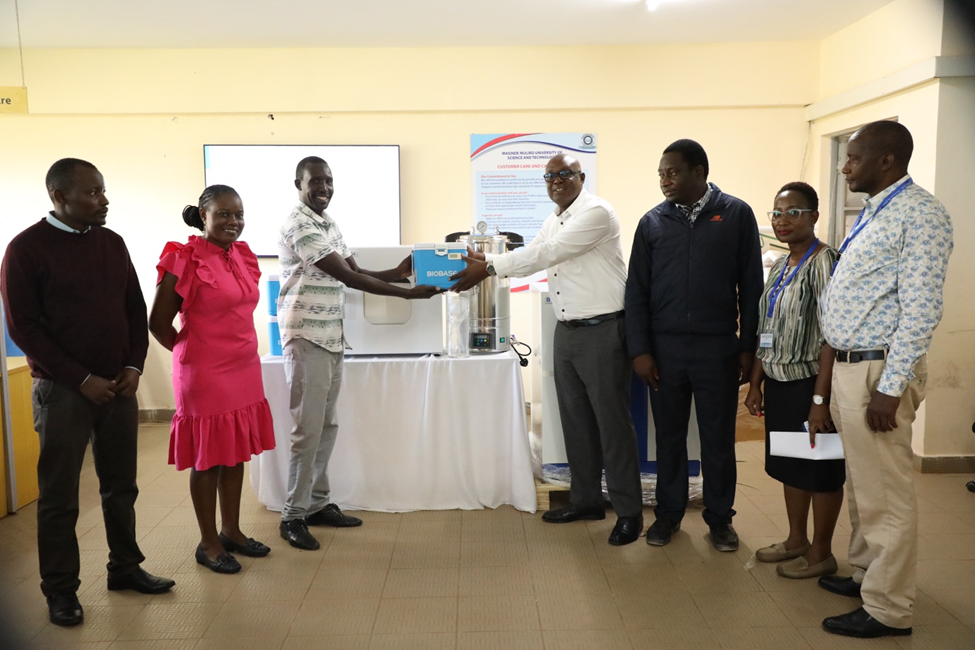
In an effort to advance research on Clostridioides difficile infections and antimicrobial resistance in Western Kenya, Masinde Muliro University of Science and Technology (MMUST) has purchased state-of-the-art anaerobic laboratory equipment courtesy of GSK-Africa Open Lab Funding. The equipment was officially handed over to the School of Public Health, Biomedical Sciences and Technology (SPHBS&T) on 17th June, 2026, by the Project Principal Investigator, Dr. Sammy Kimoloi. This equipment comprises an anaerobic incubator, which will be used to grow and study C. difficile bacteria under oxygen-free conditions, a laboratory sterilizer, anaerobic jars, and transport cooler boxes for preserving samples at 4°C for up to 24 hours. The equipment will enhance the University’s capacity to investigate the occurrence, transmission, and antimicrobial resistance patterns of C. difficile bacteria, which causes severe diarrhea infections in hospitals and communities worldwide. It will also strengthen MMUST’s contribution to disease surveillance and evidence-based public health interventions in the region. The equipment was received by the Director AIDS Control, Gender and Disability Mainstreaming, Prof. Benedict Alala, who represented the Deputy Vice Chancellor (Planning, Research and Innovation).
Speaking during the handover ceremony, Prof. Alala commended the School for attracting research funding and partnerships that enhance the University’s research and innovation agenda. “Research should not remain within the University but should extend to the community by providing practical solutions to societal challenges. As a Division, we congratulate the School of Public Health for this milestone and look forward to more innovation-driven initiatives that will translate into meaningful solutions for society,” he said.
Additionally, Prof. Alala noted that the equipment will support research and postgraduate training not only within SPHBS&T but also in the Schools of Medicine, Nursing, and Natural Sciences.
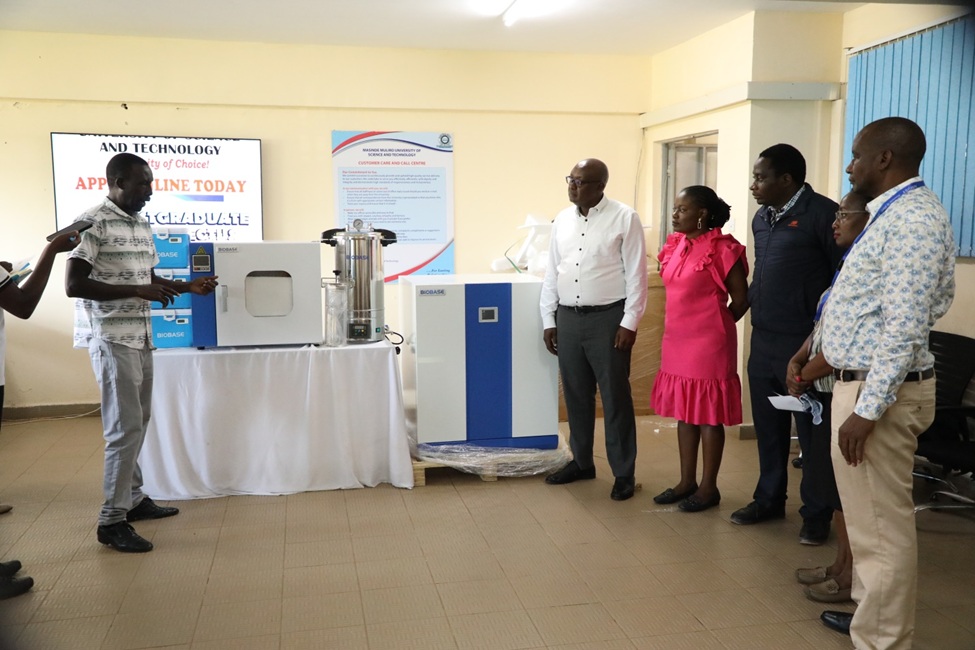
Dr. Sammy Kimoloi (left) explaining about the equipment.
On his part, the Principal Investigator of the Project ‘Molecular Epidemiology of Hospital-onset Clostridioides Difficile Infections and Antimicrobial Resistance in western Kenya’, Dr. Sammy Kimoloi, explained that the equipment was purchased courtesy of a GSK-Africa Open Lab funding, which was awarded to the team in 2025. He noted that the project seeks to bridge critical knowledge gaps on C. difficile, a globally significant pathogen whose epidemiology remains largely understudied in Kenya and across Africa.
“Globally, C. difficile is a leading cause of hospital and community acquired diarrhea with an ever rising mortality rate, disability-adjusted life years and resistance to antibacterial agents. This has led to declaration of C. difficile as one of the five urgent health threats that requires urgent and concerted prevention and control measures at the global scale. Several countries have conducted comprehensive molecular epidemiological studies and established nationwide and transnational C. difficile surveillance systems. As a result, several C. difficile control, prevention and treatment guidelines have been established in those countries, with great success in reducing C. difficile infection burden. However, despite its global public health importance, very little is known about the molecular epidemiology and antimicrobial resistance profiles of C. difficile in Kenya and other African countries. This equipment will enable us to conduct quality laboratory investigations and generate critical data that will support disease surveillance, prevention, and control efforts,” he explained.
Further, Dr. Kimoloi expressed gratitude to GSK-Africa Open Lab for investing in research capacity at MMUST. “We are grateful to GSK-Africa Open Lab for funding this project and making it possible for us to acquire this equipment. Their support will strengthen our research capacity, facilitate the training of young scientists, and contribute to improved healthcare outcomes in the region,” he added.
MMUST team after the handover of the equipment.
Echoing Prof. Alala’s sentiments, the Associate Dean of the School, Dr. Mustafa Barasa, described the acquisition as a major milestone in strengthening multidisciplinary research and training within the University.
“This is an important step towards positioning our School as a leading research hub. These investments will enhance postgraduate training in the Departments of Clinical Medicine, Medical Laboratory Sciences, Optometry and Vision Sciences, and Public Health, while promoting collaborative research that addresses real-world health challenges across the University,” he said.
Similarly, the Chairperson of the Department of Medical Laboratory Sciences, Dr. Christine Wanjala, welcomed the acquisition of the equipment, noting that the equipment brings the School closer to establishing a fully equipped laboratory capable of supporting world-class research and innovation.
Dr. Kimoloi will steer this multi-institutional research with support from the Project Co-PIs, Dr. Benjamin Ochieng from Kenya Medical Research Institute/Centre for Global Health Research (KEMRI/CGHR); and Dr. Francis Ochieng, an adjunct lecturer from the Department of Internal medicine, MMUST as well as a Specialist in Internal Medicine at Lanet regional hospital, Nakuru. Other mentors and senior collaborators in the Project include, Prof. Jesse Gitaka, a Physician Scientist, and Principal Investigator Mount Kenya University and Dr. Christine Bii (PhD), a Senior Principal Research Scientist at the Center for Microbiology Research-KEMRI, Nairobi Kenya.
Certainly, the project is expected to benefit postgraduate students, early-career researchers, healthcare professionals, and communities within and beyond Western Kenya. By strengthening research on Clostridioides difficile, MMUST is contributing to improved disease surveillance, enhanced prevention and control, and better public health outcomes across the region.
Story by Caren Nekesa, James Nyachoti and Frida Simiyu
Photos by Shiundu Masafu